IGCSE, A Levels, IB or AP? A Parent’s Comparison Guide
IGCSE, A Levels, the IB Diploma and AP are not four interchangeable options at the same school stage. IGCSE and International GCSE usually sit before advanced study. A Levels and the IB Diploma are possible later pathways, while AP comprises individual advanced courses within a wider school programme. Start with the student’s current stage and the subjects their school can actually offer.
- Compare complete programmes and real subject combinations, not just familiar names.
- Check required subjects and levels for the next course before narrowing choices.
- Look at the assessment calendar and school support, as well as the syllabus.
- Confirm transfers and recognition with the receiving institution in writing.
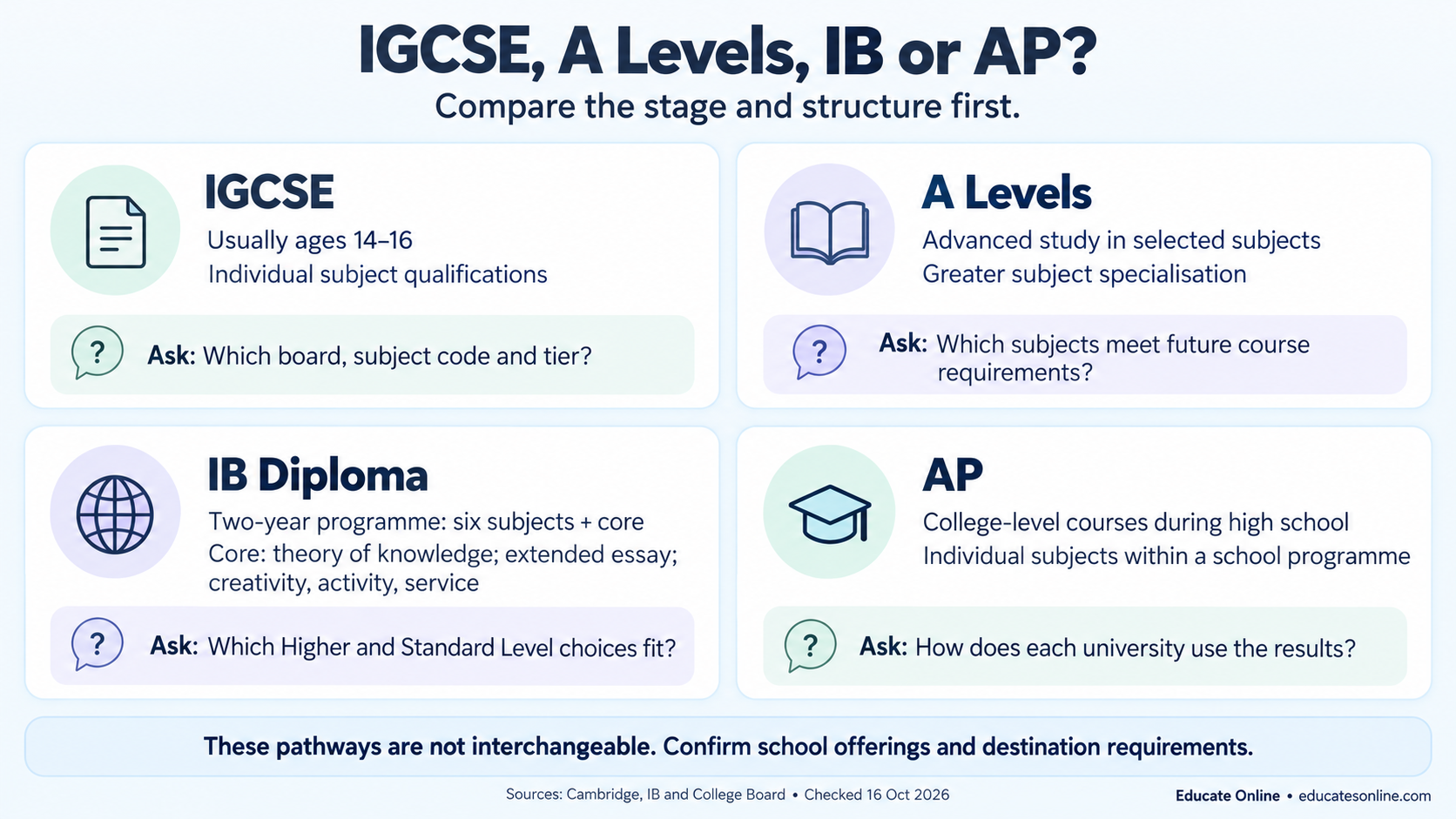
Which qualifications are you comparing?
| Route | What it is | Main planning question |
|---|---|---|
| IGCSE / International GCSE | Separately assessed secondary subjects; Cambridge IGCSE is designed principally for ages 14–16. | Which board, syllabus code, tier and examination year apply? |
| AS / A Level | Advanced subject qualifications, commonly studied in a smaller selection of subjects. | Which subjects are needed next, and how does this qualification handle AS and full A Level assessment? |
| IB Diploma Programme | A programme for ages 16–19, combining six subjects and the DP core. | Which Higher Level and Standard Level combinations can the school timetable? |
| AP | Individual college-level courses and exams available during high school. | How do the selected courses fit graduation requirements, preparation and university policies? |
A student can move from IGCSE to more than one advanced pathway if the receiving school accepts the entry requirements. Conversely, the word “IB” alone is incomplete: the IB offers programmes at different stages, and this guide focuses on the Diploma Programme.
IGCSE and International GCSE: identify the actual course
Families may encounter Cambridge IGCSE or Pearson Edexcel International GCSE. Similar subject names do not mean identical content or papers. Record the awarding body and course code before choosing textbooks, practice papers or tutoring.
Also ask which options are compulsory, which combinations fit the timetable and whether the proposed subjects support the student’s next step. A broad list of qualifications advertised by a school does not tell you what one student can take together. For a concrete example, see our Cambridge 0580 and Pearson 4MA1 Maths comparison.
A Levels: depth makes subject choice important
A Level pathways let students concentrate on a smaller subject selection. The useful question is not simply whether the learner likes specialisation, but whether the proposed combination leaves their intended next courses open.
Ask how assessment works for the exact qualification. Cambridge International AS & A Levels have their own structure; other awarding bodies and domestic qualifications may differ. Do not assume an AS result contributes to a full A Level, or that a completed unit transfers to another board. Ask the school to explain the permitted route, examination series and any practical or coursework components.
Before choosing subjects for a degree goal, read the destination course’s official requirements. A familiar course title is not enough to establish that a particular subject, level or combination is accepted.
The IB Diploma: plan the whole workload
The IB Diploma curriculum combines six subjects with Theory of Knowledge, the Extended Essay and Creativity, Activity, Service. Students take three or four subjects at Higher Level, with the remaining subjects at Standard Level. Subject-choice rules allow some alternatives to an arts subject; confirm the combination with the school.
Look beyond the number of subjects. Ask for the internal-assessment and core deadlines, the school’s feedback arrangements and the subjects it can provide at the required level. A student may value continuing languages, sciences and humanities together, but still need a realistic plan for overlapping assignments. Neither breadth nor specialisation automatically makes a programme easier.
AP: choose courses within a complete school plan
College Board describes AP as college-level courses and exams taken in high school. AP is not a substitute for checking the school’s diploma or graduation requirements. There is no universally correct number of AP courses for every student.
Start with preparation for the proposed subject, available school support and the existing workload. Then check the relevant universities’ admission, placement and credit policies: these are separate decisions. Credit is not automatic, and a demanding course choice is only useful if it fits the student’s overall plan.
A decision table for the school meeting
Use one row per issue and compare only options that are genuinely available. Write “not confirmed” where an answer is missing, then name the person who can resolve it.
| If this matters most… | Ask for this evidence | Avoid this shortcut |
|---|---|---|
| A specific degree goal | Official entry requirements and the school’s available subject/level combination. | Choosing by a curriculum’s reputation alone. |
| Keeping options open | Which subjects remain available later and which prerequisites would be lost. | Assuming more subjects always means more suitable options. |
| Managing workload | An assessment calendar, realistic independent work and support arrangements. | Ranking difficulty only by subject count. |
| A possible relocation | The receiving school’s placement, credit or assessment recognition and completion date. | Assuming the same qualification name guarantees a smooth transfer. |
| A current subject difficulty | Recent work showing the precise knowledge or method gap. | Changing an entire pathway before investigating one learning issue. |
The UCAS entry-requirements guide is a useful starting point for UK applications, but the individual course page remains essential. Save the page and date checked, especially where required subjects or equivalent qualifications are unclear.
Two examples of using the comparison
A student is interested in engineering
First list a few realistic course destinations and their published subject requirements. Next ask which A Level, IB or school/AP combinations would meet those requirements. Then compare the student’s preparation and the school’s teaching support. This order is more useful than choosing a programme first and discovering a missing prerequisite later.
A family may move during advanced study
Ask both schools about exact subject matches, assessed work already completed and the likely finishing date. Request a written plan for any gaps. If the destination school is unknown, record that uncertainty rather than calling any programme automatically portable. These are illustrative planning situations, not admissions or transfer guarantees.
Turn the decision into a useful tutoring brief
Once the school course is confirmed, share its name, board, subject, level, current topic and recent teacher feedback. A learner about to begin A Level Maths can use our algebra readiness check to identify specific practice needs.
Educate Online provides subject tutoring and exam preparation; it does not award qualifications, school credits or admissions decisions. Browse our curriculum support and tutoring subjects to discuss support within the learner’s confirmed programme.
Frequently asked questions
Are AP and IGCSE alternatives at the same school stage?
Not usually. Cambridge IGCSE is designed principally for ages 14–16. AP offers individual college-level courses during high school. Compare the whole school programme and next step rather than treating the qualifications as interchangeable.
Does IB always mean the Diploma Programme?
No. IB offers more than one programme. This guide compares the Diploma Programme: a two-year course with six subjects and a core. Confirm the student's exact programme before choosing subjects or tutoring support.
Does one pathway guarantee admission or university credit?
No. Universities and individual courses set their own admission, placement and credit policies. Check the destination institution's current requirements, including any required subjects and levels, before finalising a programme.
What should we check before moving schools during a course?
Ask both schools about subject and level matches, work already assessed, recognition of completed units and the expected completion date. Record unanswered questions rather than assuming that similar course names mean an automatic transfer.
Sources
External references for the topics covered in this guide.
- Cambridge IGCSE: programme overview (opens in a new tab)Cambridge International Education · cambridgeinternational.org
- Edexcel International GCSEs: qualification overview (opens in a new tab)Pearson Edexcel · qualifications.pearson.com
- Diploma Programme: curriculum and core (opens in a new tab)International Baccalaureate · ibo.org
- AP courses and exams (opens in a new tab)College Board · apstudents.collegeboard.org
- What is AP? (opens in a new tab)College Board · apstudents.collegeboard.org
- Cambridge International AS & A Levels (opens in a new tab)Cambridge International Education · cambridgeinternational.org
- Diploma Programme curriculum and subject choices (opens in a new tab)International Baccalaureate · ibo.org
- University entry requirements (opens in a new tab)UCAS · ucas.com