British vs American Curriculum: A Parent’s Decision Guide
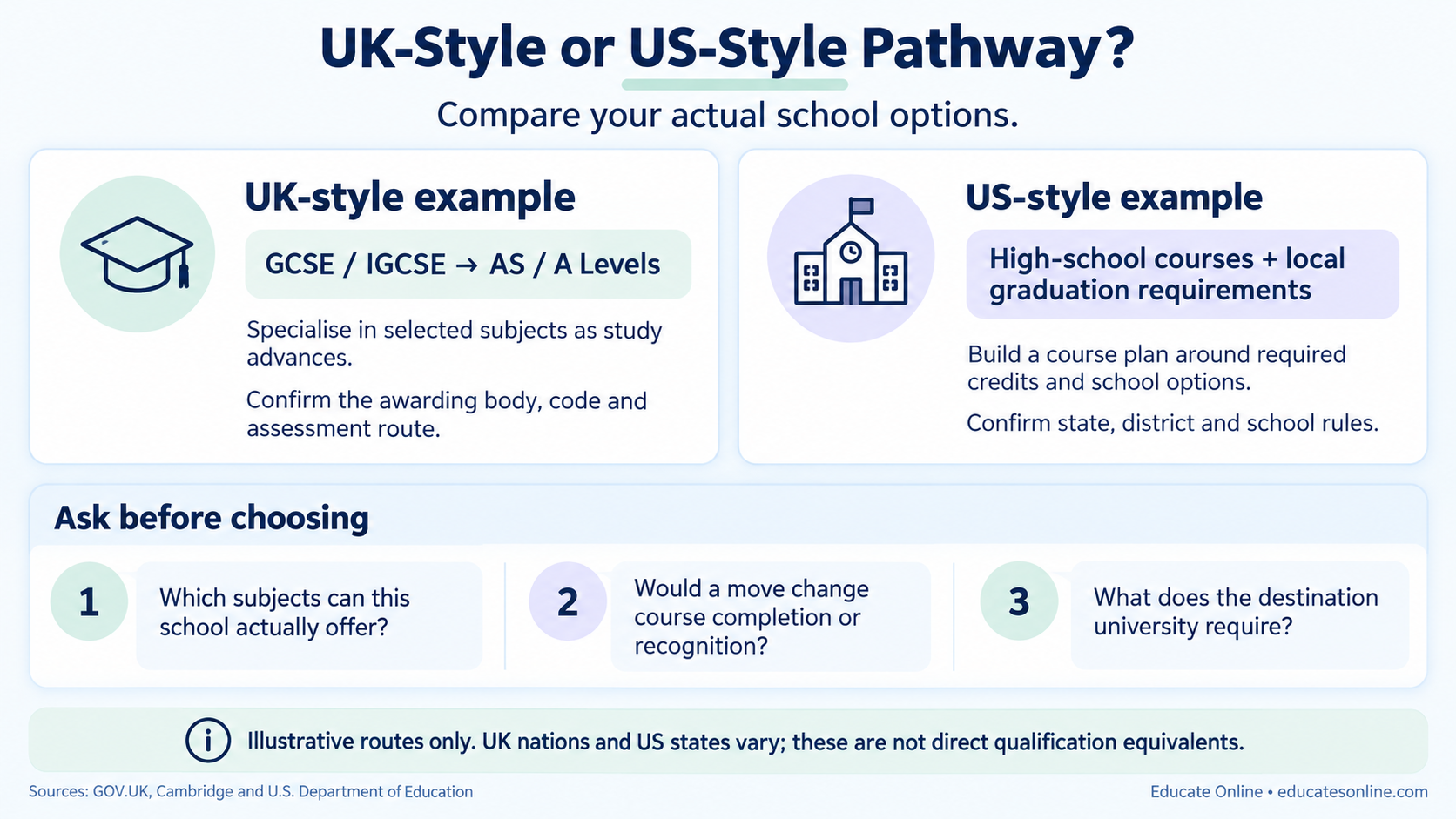
Choose between a British-style and an American-style school programme by comparing the actual subjects, assessment and next-step requirements at the schools available to your child. A common difference is that an A Level route narrows to a small subject selection, while a US high-school route usually retains several subject areas within graduation requirements. Neither label, by itself, tells you which school or programme will suit the learner better.
- There is no single curriculum used throughout either the UK or the US.
- Compare the qualification or diploma being awarded, not just the school brochure.
- Check subject prerequisites and recognition before transferring or narrowing options.
- Ask schools to confirm placement; year and grade numbers are not interchangeable.
What do “UK curriculum” and “US curriculum” mean?
“British curriculum” is often used by international schools for an England-style pathway, sometimes leading to GCSE or International GCSE and then A Levels. It should not be treated as a description of every UK school. Education differs across England, Scotland, Wales and Northern Ireland, and international schools may combine programmes.
The official national curriculum guidance describes England and links to the other UK nations. Even within England, not every type of school has the same obligation to follow the national curriculum. Ask the school which framework it uses and which organisation awards the final qualifications.
In the US, curriculum and graduation arrangements vary by state, district and school. The US Department of Education explains that education is primarily a state and local responsibility. An international school offering an American-style programme should therefore explain its own standards, diploma requirements and recognition arrangements rather than relying on the word “American”.
Compare the practical differences
| Decision area | British-style qualification route | American-style high-school route |
|---|---|---|
| Course structure | A school may offer GCSE/IGCSE followed by A Levels, or another advanced programme. | A school sets a course plan leading to a high-school diploma within its applicable requirements. |
| Subject breadth | An A Level route commonly concentrates on fewer subjects in greater depth. | A diploma plan commonly includes required subject areas alongside electives and advanced options. |
| Assessment evidence | Qualification results depend on the specific board, subject and assessed components. | Course grades and credits build a transcript; additional examinations may also apply. |
| Advanced study | Confirm each A Level or other advanced qualification’s subject requirements. | Confirm which AP or other advanced courses are offered and how students enter them. |
| Moving schools | Check syllabus coverage, assessment routes and work already completed. | Check how the receiving school evaluates completed courses and credits. |
| University preparation | Check the required qualifications, subjects, grades and any additional assessments. | Check diploma, transcript, course and testing requirements for each destination. |
These are planning patterns, not rules for every school. Neither system is simply “all exams” or “all coursework”. Request the assessment plan for the actual subjects, including practical, written, oral or project components where relevant.
Understand A Levels, AP and the school diploma
Cambridge International AS & A Levels are one example of an advanced subject route. A student considering it should check the intended subject combination, entry requirements and assessment structure with the school. The presence of A Levels does not mean every advertised subject can be combined in one timetable.
AP courses and exams offer advanced study during high school. AP is not a complete high-school diploma. A school must explain how an AP course fits the student’s graduation plan, and a university decides separately how it treats an AP result for admission, placement or credit.
For a comparison with the IB Diploma and earlier qualifications, use our IGCSE, A Levels, IB and AP guide. Avoid assuming that taking more advanced subjects is always the strongest choice; preparation, required subjects and a sustainable workload matter.
If your family is relocating, request these five answers
- Placement: Which year or grade would the student enter, on what start date, and how is that decision made? Supply age and completed study rather than converting the number yourself.
- Course match: Which topics and subject levels align, and which gaps would need bridging? Ask about Maths sequences, languages and any required local subjects.
- Recognition: Which completed courses, units or assessments would the receiving school accept? Ask who makes that decision and what documents they require.
- Completion: Would the proposed move affect the expected diploma or qualification date? Check examinations, practical work and coursework deadlines.
- Support: Who will review the transition, and what evidence will show whether the learner is settling academically?
Keep the answers together with a named school contact and an unresolved-questions list. A verbal statement that “students transfer all the time” does not settle an individual credit or assessment question.
A worked comparison for a moving family
Imagine a student has completed one year of an International GCSE Maths course and may join an American-style school. The family first obtains the current syllabus and a summary of topics studied. The receiving school then confirms placement and how the completed course is evaluated. A tutor can help with an identified algebra or geometry gap once that plan is clear; tutoring cannot decide credit recognition.
If the move goes in the other direction, the same process applies: compare actual coverage with the new qualification and its assessment requirements. A course called “Maths” and a course called “Algebra” may organise overlapping content differently. This example illustrates the questions to ask, not a promised placement outcome.
Choose using evidence from the learner and school
List two or three realistic options, then compare the student’s subject interests, recent work, preferred balance of subjects, available support and likely next steps. Ask the learner which parts of the current programme feel productive and which feel difficult. Separate a problem with one topic or learning environment from a reason to change the whole curriculum.
For each option, record one advantage, one unresolved concern and the evidence still needed. Where university plans exist, work backwards from the actual course requirements. Where plans are undecided, ask which later choices would remain available. No curriculum label guarantees admission.
Where tutoring can help
Tutoring can address a defined subject gap, reinforce a new method or help the learner practise the correct assessment format. Share the confirmed school programme, level, subject and current work before arranging support.
Educate Online offers curriculum-aligned tutoring across a range of pathways. Browse our subjects or contact us with the school course details. School enrolment, transcripts, credits and qualification recognition remain matters for the relevant schools, awarding bodies and destination institutions.
Frequently asked questions
Is there one curriculum used throughout the UK or US?
No. Education differs across UK nations, and US course and graduation requirements depend on state, district and school arrangements. Confirm the actual programme offered by the student's school.
Does following a UK-style pathway mean the student must take A Levels?
No. GCSE or IGCSE followed by AS or A Levels is one example, not a universal route. Check the school's available qualifications and the requirements of the student's intended next course.
Does an AP course replace a complete high-school programme?
No. AP comprises individual advanced courses and exams taken within a school programme. Graduation and university admission or credit requirements must be checked separately with the relevant institutions.
What should I compare if our family may relocate?
Compare subject availability, curriculum coverage, credit or qualification recognition and the likely completion date with both schools. Similar year-group labels do not by themselves establish equivalence.
Sources
External references for the topics covered in this guide.
- The national curriculum in England (opens in a new tab)GOV.UK · gov.uk
- Cambridge International AS & A Levels (opens in a new tab)Cambridge International Education · cambridgeinternational.org
- The federal role in education (opens in a new tab)U.S. Department of Education · ed.gov
- What is AP? (opens in a new tab)College Board · apstudents.collegeboard.org