What Selective Universities Look For: Requirements and Evidence
Selective universities look for evidence that you can manage their academic work and contribute to their learning community, but each institution decides what that means. Start with the exact course requirements, then build a truthful record of your learning, interests and responsibilities. There is no activity list or application formula that guarantees admission.
This guide covers Ivy League applications and other selective universities. It uses Yale, MIT and UK admissions guidance as distinct examples; MIT is not an Ivy League institution, and a US admissions approach should not be treated as a universal UK application rule.
What to do first
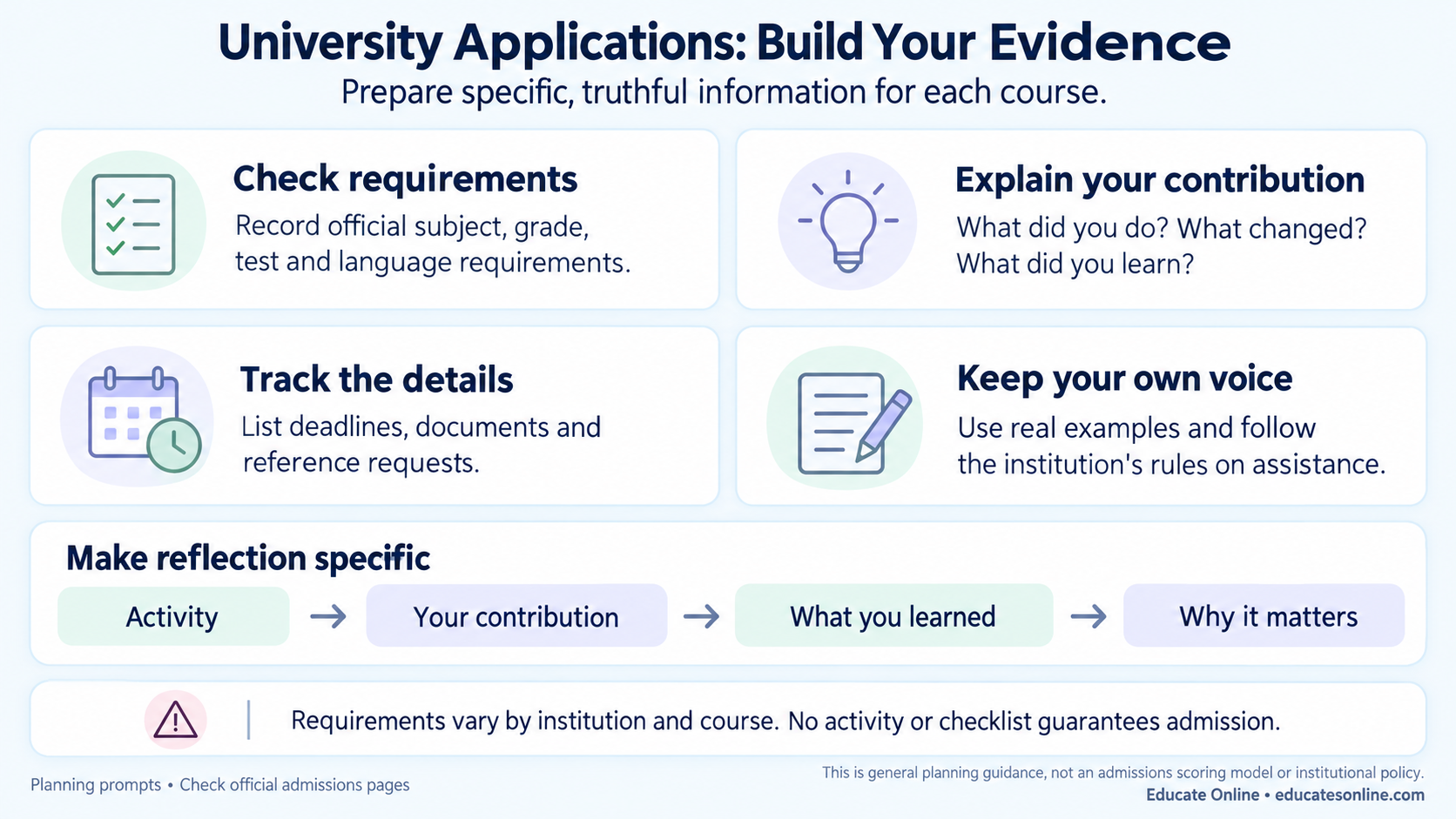
- Check the course, entry year and your qualification route on official pages.
- Separate minimum requirements from evidence that helps explain your suitability.
- Record what you actually did and learned, including work and family responsibilities.
- Build several realistic options instead of relying on one highly selective university.
Academic preparation comes before application decoration
At Yale, academic strength is the first consideration, with the school transcript central to understanding achievement over time. Yale also discusses curiosity, contribution and how applicants use their opportunities. This is Yale’s explanation of its process, not a numerical scoring formula for every university.
For your own planning, identify the subjects and levels needed for the courses you are considering. Bring current schoolwork to a teacher and ask which gaps would make the next stage harder. Taking an extra qualification solely for its name may be less useful than learning the required material well; confirm the actual requirements before changing your programme.
Do not convert one school’s grades into another system using an unofficial table and assume the result settles eligibility. Ask the university how it assesses your exact qualification if its published international guidance does not answer the question.
Build a requirements sheet for each university
UCAS explains that UK entry requirements vary by provider and course. Requirements can include particular subjects, qualifications, grades and additional selection steps. Read the programme page as well as the general admissions page. For US institutions, check the relevant first-year admissions instructions and any programme-specific requirements.
| Record | Question to resolve |
|---|---|
| University, course and entry year | Am I reading the correct applicant category and intake? |
| Qualifications and subjects | Are my programme, subject combination and levels accepted? |
| Tests and language evidence | What is required for this cycle and when must evidence arrive? |
| Written work or other selection steps | Are essays, a portfolio, an interview or an additional test needed? |
| Deadlines and documents | Which actions belong to me, my school and my referees? |
| Costs and funding | What official information do we need to judge affordability? |
| Official link and checked date | Where can I verify the answer if the guidance changes? |
Leave uncertain entries marked “to confirm”. Testing policies and application arrangements can change between cycles, so a friend’s experience from last year is not a substitute for the current instructions. Where two official pages appear inconsistent, ask the admissions office rather than choosing the more convenient answer.
Turn an interest into evidence you can explain
MIT’s admissions guidance describes qualities including initiative, collaboration and curiosity, and recognises different ways of contributing. Use such guidance to understand an institution’s values, then consider whether its environment suits you. Do not manufacture a project to imitate somebody else’s application.
A useful record explains a real experience in enough detail that you can discuss it honestly. Include the task, your individual contribution, something that changed your understanding and a sensible next question. Numbers can clarify an outcome when they are accurate, but not every valuable responsibility produces a measurable result.
An original application-evidence example
“Interested in engineering” gives little information. A student might instead record: “I built a small model bridge, tested it with increasing loads and found that a weak joint failed before the main beam. I changed the joint and compared the two designs.” This is an invented example of reflection, not an applicant success story.
- Action: built and compared two designs.
- Personal contribution: identify the parts the student designed or tested.
- Evidence: sketches, measurements or dated notes actually created during the work.
- Learning: explain the unexpected failure and the limits of the experiment.
- Next question: decide what further comparison would be worthwhile.
The same structure can describe helping in a family business, caring responsibilities, a reading project, an arts activity or sustained community work. Keep private information private and do not inflate a shared achievement into an individual claim. The aim is to understand your experience, not to collect impressive labels.
Write and request references with care
Read each application question before drafting. An answer about why a course interests you needs a different focus from an answer about a challenge. Use a concrete example and explain its relevance; remove claims you cannot support. Editing should make your meaning clearer while preserving your voice.
Ask prospective referees early, follow the institution’s rules on who may provide a recommendation, and give them accurate information about deadlines and your recent work. Yale specifically notes the value of teachers who know the applicant well. Do not write a reference for someone to sign or imply that a particular reference guarantees admission.
Check the application’s own rules on outside assistance and AI. Keep drafts and source notes, and make sure every submitted statement is true. A polished sentence is not useful if it misrepresents your contribution or does not answer the prompt.
Choose next steps you can control
For the coming month, select one academic priority, one requirement to clarify and one existing interest to pursue further. For example: improve algebra fluency, confirm accepted subject levels, and continue a reading project with a short reflection after each text. These are achievable actions rather than admission predictions.
Discuss a balanced university list with your school adviser and family, considering course fit, affordability, location and support as well as selectivity. Educate Online provides subject tutoring and exam preparation; universities make admission decisions. If subject choice is still uncertain, use our curriculum comparison to organise questions before consulting your school.
Frequently asked questions
Do Ivy League universities use one admissions formula?
No. Each institution reviews applicants under its own process and current requirements. Strong grades or a particular activity cannot guarantee admission, so read the relevant university's guidance and maintain several suitable options.
Do I need expensive activities or a long list of awards?
There is no universal requirement for a particular activity package. Explain your actual interests, responsibilities and contribution accurately, in the context of your opportunities. Check any specific course or portfolio requirements separately.
How do I check international qualification requirements?
Use the university's official guidance for your qualification, course, entry year and applicant category. If your subject combination or level is unclear, ask admissions directly rather than relying on an unofficial conversion table.
Can subject tutoring guarantee a university offer?
No. Subject tutoring can address learning gaps and support exam preparation, but the university controls selection. A useful academic plan starts with current work and the requirements of the intended course.
Sources
External references for the topics covered in this guide.
- What Yale Looks For (opens in a new tab)Yale Undergraduate Admissions · admissions.yale.edu
- What we look for (opens in a new tab)MIT Admissions · mitadmissions.org
- University entry requirements (opens in a new tab)UCAS · ucas.com