Cambridge 0580 vs Edexcel 4MA1: IGCSE Maths Compared
Cambridge 0580 and Pearson Edexcel 4MA1 require different exam preparation. For Cambridge 0580 exams in 2025–2027, each tier includes a non-calculator paper and a calculator paper. Pearson 4MA1, the linear Mathematics A route, permits a calculator in both papers. Their tier names, grade scales and paper identifiers also differ.
Neither a board’s name nor one year’s grade boundary proves that it will be easier for an individual student. Use this comparison to confirm the course, select the right practice papers and identify gaps. The school or examination centre must confirm the student’s entry.
Key takeaways
- Check the exact code: 0580 and 4MA1 are not interchangeable paper folders.
- Match the tier, examination year and paper variant before a timed mock.
- Practise shared skills, but follow the confirmed course’s calculator rules and assessment format.
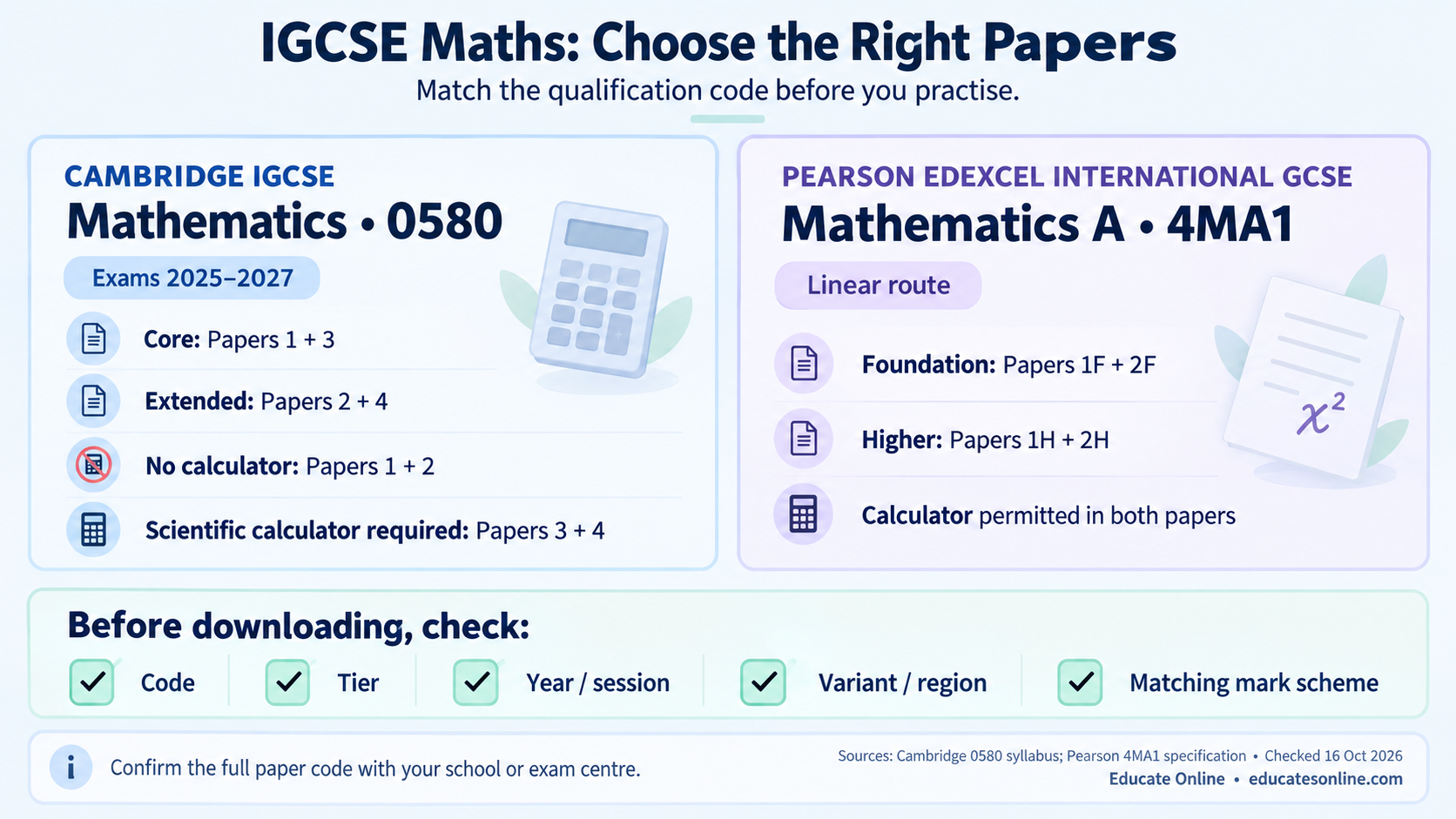
Start with a course identification card
Copy these details from the school or examination centre into one note. Keep it beside your revision folder so everyone chooses materials for the same course.
- Awarding body: Cambridge International or Pearson Edexcel.
- Qualification and code: use the full name, not just “Maths”.
- Tier: Core or Extended for 0580; Foundation or Higher for 4MA1.
- Exam year and series: ask the centre to confirm both.
- Paper identifiers: include any variant or regional suffix supplied by the centre.
- Current syllabus/specification: save its official link, along with any updates your school identifies.
Do not infer an entry from a textbook cover. Books can support more than one syllabus or remain in use after an assessment change.
The paper structures at a glance
| Route | Papers | Time and marks per paper | Calculator |
|---|---|---|---|
| Cambridge 0580 Core | 1 and 3 | 90 minutes; 80 marks | Paper 1: no. Paper 3: scientific calculator required. |
| Cambridge 0580 Extended | 2 and 4 | 2 hours; 100 marks | Paper 2: no. Paper 4: scientific calculator required. |
| Pearson 4MA1 Foundation | 1F and 2F | 2 hours; 100 marks | Calculator permitted in both. |
| Pearson 4MA1 Higher | 1H and 2H | 2 hours; 100 marks | Calculator permitted in both. |
Each paper contributes half of the qualification in these routes. Cambridge 0580 Core offers grades C–G and Extended A*–E. Pearson 4MA1 Foundation offers 5–1; Higher targets 9–4 with an allowed grade 3. These are different grading scales, so do not treat similar-sounding tier names as direct equivalents. Sources: Cambridge 0580 syllabus, assessment overview and Pearson 4MA1 specification, qualification overview and awarding section.
Which board is harder, and which should you choose?
A useful comparison starts with the student. Someone who relies heavily on calculator arithmetic needs specific non-calculator preparation for 0580. Someone who calculates accurately but struggles to model a word problem still needs that skill when a calculator is available. Neither observation establishes a universal difficulty ranking.
If the school has already chosen the board, focus first on preparation for that course. If there is a real choice, compare the teaching available, entry arrangements, completed content and next-course requirements. Do not switch simply because a different board’s paper looks friendlier after seeing its worked solution.
The grade scales also differ. Use the destination institution’s published requirements if you need to establish an acceptable qualification or grade; this guide does not supply a universal conversion between A*–G and 9–1.
Three easy mix-ups to prevent
Using older Cambridge papers as a current mock
The 2025–2027 Cambridge 0580 syllabus includes a non-calculator paper at each tier. An older paper may still contain useful topic questions, but check it against the current content and format before using it to judge timing or readiness. Keep “topic practice” and “current-format mock” in separate folders.
Confusing Pearson linear and modular Maths A
Pearson also offers a modular Mathematics A route, with qualification cash-in codes 4XMAF and 4XMAH. That route has its own unit specifications. The 4MA1 table above is not a modular revision plan. If those codes appear in your entry information, ask for the correct unit codes and materials.
Choosing by topic name alone
“Algebra” can describe anything from collecting like terms to a multi-step equation problem. Match the exact skill, tier and depth to the specification. A harder-looking question from another course is not automatically useful, particularly when the student still needs to learn the underlying method.
How to build a paper folder you can trust
- Start at the official qualification page. Use Cambridge 0580 or Pearson Mathematics A. Ask the school for materials that are not publicly available.
- Read the front page before starting. Check code, tier, session, duration and calculator instructions. A filename from a third-party folder is not sufficient evidence.
- Pair the question paper with its own mark scheme. Similar paper names can hide different variants. Do not use another session’s scheme.
- Label its purpose. Write either “topic practice” or “mock under current conditions”, and record any adjustments.
- Keep the review with the attempt. Record the first step that went wrong, the corrected method and one follow-up question.
Two original examples: one skill, a deliberate method
These examples practise useful mathematical habits. They are not official questions, an exhaustive content checklist or a prediction of either board’s exams.
Example 1: calculate 5/6 − 1/4 without a calculator
The common denominator is 12. Rewrite the fractions as 10/12 and 3/12, then subtract to obtain 7/12. A quick estimate checks the scale: about 0.83 − 0.25 is about 0.58, consistent with 7/12.
If the answer was 4/2, the problem is subtracting numerators and denominators separately. Practise making equivalent fractions first. For a fresh attempt, work out 7/8 − 1/3; the answer is 13/24.
Example 2: calculate a percentage increase
A quantity rises from 240 to 276. The increase is 36, and the original amount is the comparison base. Therefore 36 ÷ 240 × 100 = 15%. Check by calculating 240 × 1.15 = 276.
A calculator can perform the division, but it does not decide whether the denominator should be 240 or 276. Write “change ÷ original” before entering numbers. Then try a change from 150 to 168: the increase is 12%.
If the student is moving between boards
Create a short topic-transfer record with four columns: skill already studied, evidence from independent work, requirement in the new syllabus, next action. For example, knowing how to add fractions is useful in both courses; being able to do it only with a calculator leaves a specific preparation task for a non-calculator paper.
Ask the receiving school to confirm what remains untaught and how the change affects the examination date. Keep any uncertainty visible. The same topic heading does not guarantee identical depth, and changing board does not automatically transfer an exam entry or completed assessment.
Plan the next week around what the attempt revealed
Choose one weak skill, explain its method in your own words, then complete a small set without worked solutions beside you. Revisit it in a mixed set later. Preserve practice without a calculator where your paper requires it, and practise entering expressions accurately where calculators are allowed.
Discuss full-paper timing only after checking the right route. Do not compare percentages from two different boards, tiers or formats as if they represented the same grade.
For support with a confirmed course, explore IGCSE tutoring and IGCSE Maths tutoring. For the broader school-pathway decision, use the parent’s curriculum comparison guide.
Request a free trial with the board, code, tier and current topic. Availability and trial arrangements are confirmed after the enquiry.
Official sources checked 16 October 2026. Assessment details must be rechecked for later examination years and the student’s confirmed entry.
Frequently asked questions
Is Cambridge 0580 harder than Edexcel 4MA1?
There is no universal answer. Calculator rules, paper demands and the student’s strengths affect the experience. Compare current specifications and independent work instead of using one raw percentage or a board label as proof of difficulty.
Can I use Cambridge papers from before 2025?
They may still provide useful topic practice, but check content and format before using them as current mocks. The Cambridge 0580 syllabus for exams in 2025–2027 includes a non-calculator paper at both Core and Extended tiers.
Is Pearson modular Maths A the same route as 4MA1?
No. This guide compares the linear 4MA1 route. The modular qualification uses cash-in codes 4XMAF and 4XMAH and has its own unit specifications. Confirm the route with the examination centre.
What should I check before downloading a paper?
Check board, qualification code, tier, exam year and series, paper identifier or variant, calculator rules and the matching mark scheme. Use the official qualification page as the starting point.
Sources
External references for the topics covered in this guide.
- Cambridge IGCSE Mathematics 0580: syllabus for 2025–2027 (opens in a new tab)Cambridge International Education · cambridgeinternational.org
- International GCSE Mathematics A: linear 4MA1 specification (opens in a new tab)Pearson Edexcel · qualifications.pearson.com
- International GCSE Mathematics A: modular specification (opens in a new tab)Pearson Edexcel · qualifications.pearson.com
- Cambridge IGCSE Mathematics 0580 (opens in a new tab)Cambridge International Education · cambridgeinternational.org
- International GCSE Mathematics A: qualification overview (opens in a new tab)Pearson Edexcel · qualifications.pearson.com