Starting A Level Maths: An Algebra Readiness Check
Before starting A Level Maths, check whether you can manipulate algebra, explain each step and use the same skill in a fresh question. This guide gives eight original questions with worked solutions on indices, factorising, algebraic fractions, rearranging, simultaneous equations, surds, functions and straight lines.
The result is a practice plan, not a predicted grade or an admissions decision. Your school sets its entry requirements and may provide transition work. These questions cover selected foundations, not the whole of Pure Mathematics, Statistics or Mechanics.
Key takeaways
- Record how independently you solved each question as well as whether the answer was correct.
- Keep exact values, brackets and restrictions visible throughout the working.
- Practise the first uncertain step, then return to a fresh mixed question without the solution beside you.
Why begin with algebra?
Algebra lets you connect numbers, graphs and general relationships. For example, the current AQA A Level Mathematics 7357 algebra content includes indices, surds, quadratics, simultaneous equations, polynomial manipulation and functions. This check selects a few building blocks from those areas; it does not cover the entire course or every awarding body’s route.
The aim is to find the first uncertain step. Someone who expands brackets correctly but chooses the wrong equation needs a different practice task from someone who models the problem correctly and then makes an arithmetic slip.
Try the eight questions first
Use paper and work without a calculator initially. Show each step, including any restrictions on a variable. If a topic is new, mark it “not yet learned” rather than guessing. Set aside enough time to think; this is not a speed test.
- Evaluate 272/3.
- Factorise 2x2 − 7x + 3, then solve 2x2 − 7x + 3 = 0.
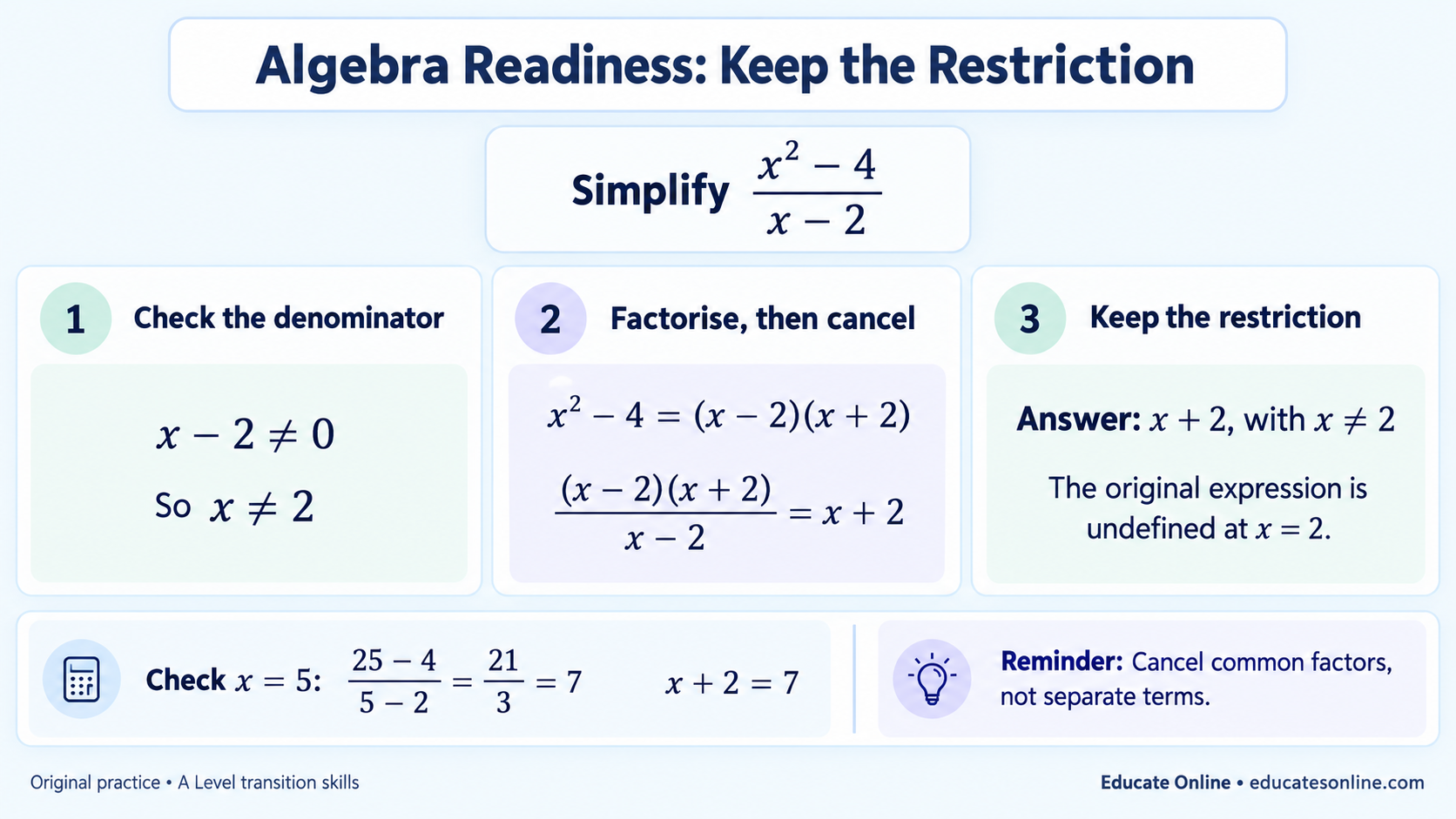
- Simplify (x2 − 4)/(x − 2), and state the excluded value.
- Rearrange v2 = u2 + 2as to make a the subject, assuming s ≠ 0.
- Solve y = 2x + 1 and y = x2 − 2 simultaneously.
- Write 1/(√5 − 2) with a rational denominator.
- If f(x) = x2 − 3x, expand and simplify f(a + 1).
- Find the equation of the line through (4, 1) parallel to y = −2x + 7.
For each question, record one of three descriptions: “independent and explained”, “correct with help” or “not yet secure”. Keep that description after marking; an answer copied from a solution does not become an independent success.
Worked solutions and what each reveals
1. Fractional indices
272/3 = (∛27)2 = 32 = 9. The denominator of the fractional index indicates the root; the numerator gives the power. Multiplying 27 by 2/3 is a different operation. Check your understanding with 163/4 = 8.
2. Factorising and solving
2x2 − 7x + 3 = (2x − 1)(x − 3). Expanding gives 2x2 − 6x − x + 3, which checks the middle term. A product is zero when at least one factor is zero, so x = 1/2 or x = 3. Factorising is rewriting an expression; solving also identifies values that make the equation true.
3. Algebraic fractions and restrictions
x2 − 4 = (x − 2)(x + 2). For x ≠ 2, the common factor cancels, leaving x + 2. Keep the restriction x ≠ 2: simplifying does not make the original expression defined at a zero denominator. Test x = 5 to see that both forms give 7.
4. Rearranging a formula
Subtract u2 to obtain v2 − u2 = 2as. Divide the whole left side by 2s: a = (v2 − u2)/(2s). Brackets matter. As a check, set u = 2, v = 4 and s = 3. The result is a = 2, and the original equation becomes 16 = 4 + 12.
5. A line meeting a curve
Both expressions equal y, so x2 − 2 = 2x + 1. Rearrange to x2 − 2x − 3 = 0, then factorise: (x − 3)(x + 1) = 0. Thus x = 3 or −1. Substitute each value into y = 2x + 1 to obtain (3, 7) and (−1, −1). Both coordinates are needed for each intersection.
6. Rationalising a denominator
Multiply the numerator and denominator by √5 + 2. The denominator becomes (√5 − 2)(√5 + 2) = 5 − 4 = 1, so the answer is √5 + 2. You have multiplied by (√5 + 2)/(√5 + 2), which equals 1, preserving the value.
7. Function notation and substitution
Replace every x with the whole expression a + 1: f(a + 1) = (a + 1)2 − 3(a + 1). Expanding gives a2 + 2a + 1 − 3a − 3 = a2 − a − 2. Writing f(a) + 1 answers a different question. Try a = 1: both the original substitution and the simplified expression give −2.
8. A parallel line
The required gradient is −2, so start with y = −2x + c. Substitute (4, 1): 1 = −8 + c, giving c = 9. Therefore y = −2x + 9. The point checks, and the coefficient of x matches the original line’s gradient.
Choose practice from the error, not the total score
- Questions 1 or 6 felt unfamiliar: practise the meaning of roots, indices and surds with simple exact values before longer expressions.
- Questions 2 or 3 broke down: expand to check factors, and distinguish cancelling factors from cancelling terms.
- Question 4 went wrong: write one inverse operation per line and keep the complete numerator in brackets.
- Questions 5 or 8 were difficult to start: practise translating a graph or relationship into equations before solving.
- Question 7 caused trouble: substitute into brackets first, then simplify. Separate the input from the function’s output.
Do not use these categories to decide whether someone is “an A Level student”. They identify manageable practice tasks. A teacher can judge which gaps need attention before the student’s particular course starts.
Check that the skill transfers to a fresh question
Reproducing a solution immediately after reading it can hide a gap. Put the worked answers aside and try these three variations later. They change the numbers and the task slightly, so you must choose the method again.
- Simplify (x2 − 16)/(x + 4), including the restriction.
- Make x the subject of y = 3x/(x + 2), where x ≠ −2.
- For g(x) = 2x2 − x, expand g(t − 1).
Follow-up answers
1: Factorising gives (x − 4)(x + 4)/(x + 4), so the expression becomes x − 4 with x ≠ −4. 2: Multiply to obtain yx + 2y = 3x, then collect x terms: 2y = x(3 − y). Thus x = 2y/(3 − y), with y ≠ 3. 3: Substitute the whole input: 2(t − 1)2 − (t − 1) = 2t2 − 5t + 3.
The second problem adds a useful challenge: the new subject appears twice before factorising. If it was difficult, practise collecting the subject as a common factor; there is no need to restart every algebra topic.
A manageable transition routine
Choose two weak skills for the first week. In each short session, explain a worked method, close it, attempt a fresh question and check the reasoning. At the end of the week, mix the skills with some questions you already know. Return to the weak skills the following week without the original solutions beside you.
For additional official bridging material, Pearson’s GCSE-to-A-Level transition resources offer videos and downloadable practice. Use the chapters that match the gaps you found and your teacher’s plan. OCR’s transition guidance also stresses checking foundations before moving into new content.
For broader planning once the course is underway, read our A Level revision techniques guide. Keep your school’s transition tasks and specification as the main reference.
Explore A Level tutoring support or A Level Maths tutoring. If you would like to discuss specific gaps, request a free trial, sharing your board and a short description of where the working breaks down. Trial arrangements depend on confirmation.
Official course and transition references checked 16 October 2026. The eight core questions, follow-up questions and worked solutions are original learning examples, not official assessment items or evidence of exam-board endorsement.
Frequently asked questions
What algebra should I revise before A Level Maths?
Start with indices and surds, expanding and factorising, algebraic fractions, rearranging formulae, equations, functions and graphs. Use your school’s transition tasks to identify the exact course priorities.
Does a high score on this check meet sixth-form entry requirements?
No. Entry requirements are set by the school or college. This short set identifies selected practice needs and does not assess the complete course or predict an A Level grade.
Why does x = 2 remain excluded after simplifying (x² − 4)/(x − 2)?
The original denominator is zero at x = 2. Cancelling a factor gives an equivalent expression only where the original expression is defined, so the restriction must remain.
What should I do after reading a worked answer?
Explain the first uncertain step, close the solution and try a fresh question later. Mix it with other skills once the method is secure; copying the original answer is not an independent check.
Sources
External references for the topics covered in this guide.