Time Management for Students: A Practical Weekly Study Plan
A useful study timetable starts with the time you actually have and ends with evidence of what you learned. Put school, travel, meals, rest and other commitments in first; then assign specific tasks to the remaining windows. Review the plan each week so one delayed assignment does not derail every subject.
This guide is for students balancing several subjects, including those studying across more than one programme. If you follow two programmes, keep their deadlines and assessment requirements separate even when topics overlap. The example below is an adjustable planning tool, not a required number of study hours.
Your starting checklist
- Keep one deadline list for all subjects and programmes.
- Plan outcomes such as “solve and check four equations”, rather than subject names alone.
- Leave space for corrections, unexpected homework and recovery.
- Judge the week by completed work and independent understanding, not time at a desk.
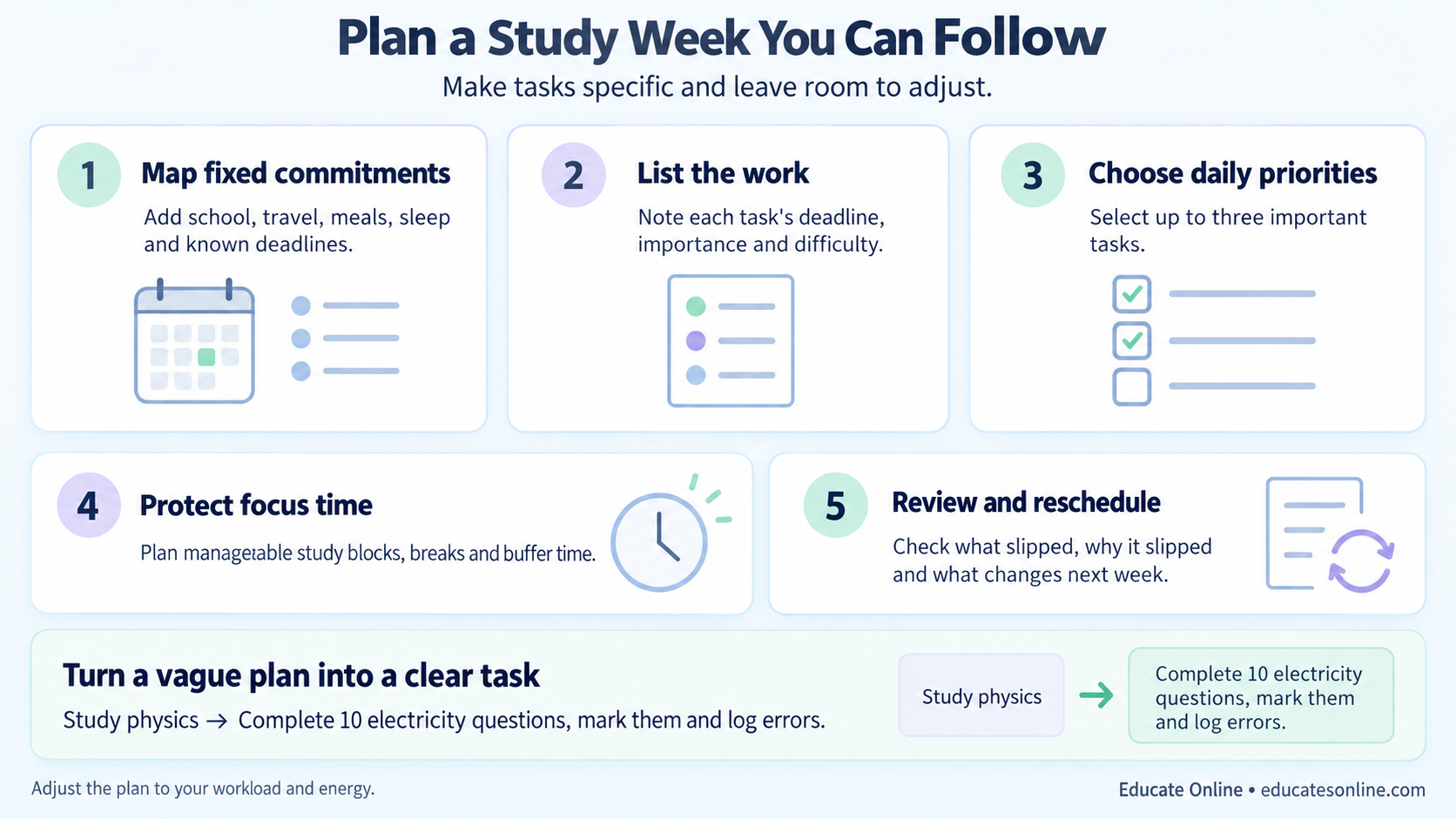
1. Find your real weekly capacity
Use a calendar to block out fixed commitments before adding independent study. Include the journey home, an after-school break, family responsibilities and activities. A blank evening is not automatically four available study hours. Ask when you can work attentively without sacrificing the commitments that make the week sustainable.
Cornell’s Learning Strategies Center distinguishes a longer-term calendar for important dates from a weekly calendar for allocating time. You can use the same distinction at school: one page shows what is coming; another shows what you will do about it this week.
For three days, record roughly how long ordinary tasks take. If a Maths assignment repeatedly needs 50 minutes, stop putting it into a 20-minute space. Include the time needed to mark answers and correct them. Estimates become useful when you revise them using your own experience.
2. Turn the workload into a short task list
For each task, record the deadline, the next concrete action and any obstacle. “Finish Biology” hides several decisions. “Explain the stages of mitosis without notes, check the textbook, then answer two questions” tells you how to begin and what completion means.
| Task | Why it needs attention | Next action |
|---|---|---|
| Maths homework due Wednesday | Deadline close; two methods uncertain | Attempt the first four questions and identify the exact stuck step |
| Biology quiz on Friday | Needs more than one recall attempt | Make five questions from the taught topic and answer them closed-book |
| English essay due next week | Large task that can be started early | Choose a position and collect evidence for two paragraphs |
Prioritise both urgency and difficulty. The nearest deadline matters, but an essay due next week may need an early start. A difficult concept may need a teacher’s explanation before you can finish the assignment. Mark that dependency and ask for help while there is still time to use it.
3. Use this worked weekly study plan
Imagine the student above has two manageable windows on Monday and Thursday, one on Tuesday and Wednesday, and part of Saturday morning. These are selected independent-study slots, not a complete timetable. Lessons, routine homework and breaks still need their own space.
| Day | Planned work | Evidence to keep |
|---|---|---|
| Monday | Maths: attempt and check four questions. Later, spend a short session recalling Biology. | Two corrected Maths steps; Biology gaps highlighted |
| Tuesday | Finish Maths homework after clarifying the stuck method. | Completed working and one fresh independent example |
| Wednesday | Plan the English argument and select supporting evidence. | A paragraph plan with a reason for each example |
| Thursday | Retry Biology questions without notes. Use the second window for unfinished work or rest. | A comparison with Monday’s answers |
| Friday | Briefly note what the quiz exposed; leave the evening lighter where possible. | One topic to revisit |
| Saturday | Draft the English response, take a break, then review its reasoning. | A draft with a specific improvement marked |
| Sunday | Review deadlines and choose next week’s priorities. | An updated plan with realistic estimates |
Notice that Biology returns on different days. Spreading learning over time and checking recall are supported in the Institute of Education Sciences study guide. The precise days and session lengths here are our example; they are not a scientifically prescribed schedule.
4. Make each session easy to start and finish
Write the first action before the session begins: open the correct paper, answer question 3, or outline one paragraph. Put unrelated notifications away. Keep a small “later” list for things that occur to you so you can return to the task without trying to remember everything.
Choose a session length you can manage and include breaks. If the work quality falls, change the plan rather than extending the timer automatically. Finish by writing one sentence: “I can now do ___ independently; I still need help with ___.” This is more informative than simply ticking “Chemistry” off a list.
5. Repair a plan that slips
When work overruns, first identify why. Too much work requires reprioritising; an unclear instruction requires clarification; a missing concept requires teaching. Moving the same blocked task to tomorrow without changing anything rarely solves the problem.
- A new urgent task arrives: use the buffer or move a lower-priority task deliberately.
- You finish early: check the answer, try a fresh example or keep the spare time free.
- A subject is repeatedly avoided: reduce the first step and bring one failed attempt to a teacher.
- Two programmes clash: check both calendars and contact the relevant teachers early; do not assume identical topics mean interchangeable assignments.
What to review at the end of the week
Ask which estimate was inaccurate, which topic improved and which task needs support. Keep the parts that worked. Our revision techniques guide explains how to turn planned time into useful practice. If one topic keeps blocking progress, explore subject tutoring with that specific difficulty in mind.
Frequently asked questions
How many hours should I study each day?
There is no universal number. Start with your actual commitments, the work due and the time tasks take. Use specific outcomes and independent checks to judge whether the time was useful, then adjust the next week.
Should every subject get the same amount of time?
Not necessarily. Consider deadlines, difficulty, recent feedback and the amount of work involved. Keep every subject visible while giving extra attention to gaps that currently block progress.
What if I follow two school programmes?
Keep each programme's course requirements, assessment instructions and deadlines clear in one overall plan. Similar topic names do not make assignments or credits interchangeable; confirm any overlap with the schools.
What should I do when I miss a study session?
Identify whether the problem was time, an unclear task or a missing concept. Move the task deliberately, shrink the next action if needed, and seek help when the same obstacle keeps returning.
Sources
External references for the topics covered in this guide.
- Managing Time (opens in a new tab)Cornell University Learning Strategies Center · lsc.cornell.edu
- Organizing Instruction and Study to Improve Student Learning (opens in a new tab)Institute of Education Sciences · What Works Clearinghouse · ies.ed.gov