Online Tutor Trial Checklist: 15 Questions for Parents
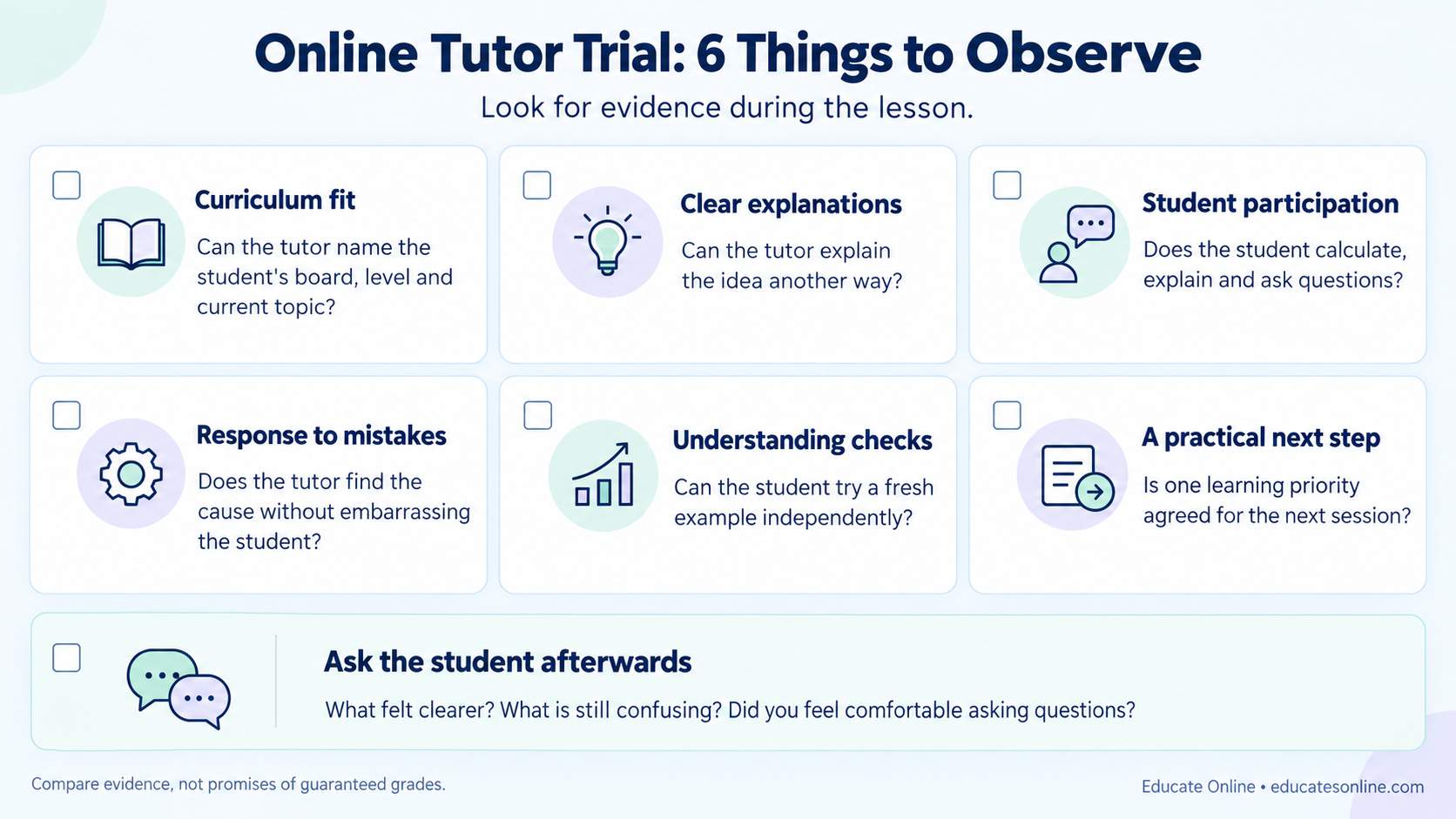
Use an online tutoring trial to check three things: whether the tutor understands the student’s course, whether the student does some independent thinking, and whether the lesson ends with a specific next step. A fluent explanation or an enjoyable conversation alone is not enough evidence of a good match. This checklist helps parents compare what actually happened before committing to regular lessons.
- Bring one recent piece of work and the student’s own question.
- Watch a fresh attempt after the explanation, not just a copied example.
- Confirm communication, safeguarding and payment arrangements separately.
- Use observations to decide whether to continue, clarify something or try another match.
Before the trial: prepare a short learner brief
Write down the student’s year or grade, exact subject and curriculum, examination board and tier where relevant, current topic, and one difficulty. Include a useful teacher comment if available. For example: “Year 10, Cambridge IGCSE Mathematics 0580, Extended; can expand brackets but struggles to factorise quadratics.” This tells a tutor more than “needs help with Maths”.
Choose one or two pieces of recent work rather than an entire school record. Leave the student’s genuine working visible, including mistakes, but remove unnecessary identifiers. Check the meeting link, audio and method for sharing written work. Tell the student that the trial is a chance to ask questions, not a performance they have to pass.
15 questions to ask before, during and after the trial
Questions 1–5: curriculum and subject fit
- Which parts of this course have you taught? Ask about the relevant level, board and subject. A general degree or broad subject label does not establish familiarity with the student’s particular assessment.
- How will you find the starting point? Look for questions about the student’s reasoning and a manageable task. A grade or age alone does not show which step needs attention.
- Which specification and materials will you use? The answer should match the school’s current course. Confirm the examination series, tier and texts where these affect preparation.
- Is the difficulty knowledge, method or exam technique? A useful distinction might be understanding a concept versus explaining it clearly enough to earn marks. Ask what evidence supports the tutor’s initial view.
- How will tutoring connect with school lessons? Discuss the current topic, teacher feedback and upcoming work. The EEF’s evidence review highlights the value of linking tuition with normal classroom teaching and monitoring progress.
Questions 6–10: what the student experiences
- Can the explanation change when needed? If the student is stuck, notice whether the tutor uses a different representation, a smaller step or a carefully chosen example.
- Who is doing the thinking? The student should have time to answer, write, calculate or explain. A screen full of the tutor’s working is not the same as student understanding.
- How are mistakes handled? Look for attention to the first wrong step and the reason behind it, without embarrassment or impatience.
- Is the pace manageable? Notice whether the student can ask for thinking time. Being challenged can be useful; being unable to follow the lesson needs an adjustment.
- Can the student try a new example? After help, ask for a related task with something changed. This gives better evidence than answering “yes” to “Do you understand?”
Questions 11–15: the ongoing arrangement
- What is the first learning priority? Ask for a concrete skill and a reason for choosing it. “Explain how to rearrange a formula” is more useful than “improve everything”.
- What practice will fit between lessons? Agree a manageable task alongside schoolwork. Ask how it will be checked, and what the student should do if they get stuck.
- How will we review progress? Confirm the form of updates, a review point and the work that will be compared. One trial cannot predict a future grade.
- What are the practical terms? Confirm the lesson duration, total price, booking process, cancellations, rescheduling and any package commitment before paying.
- How are concerns and an unsuitable match handled? Ask whom the parent contacts, how tutor changes work, and what communication channels are appropriate for the student.
A trial observation rubric you can actually use
Record a short example in each row. Use clear evidence, some evidence or not observed. “Not observed” means you need more information; it is not automatically a failing score. This is a practical comparison tool, not a validated assessment of teaching quality.
| Area | Clear evidence | Useful follow-up if unclear |
|---|---|---|
| Course fit | The task and explanation match the named course and level. | Which specification will guide the next lesson? |
| Diagnosis | The tutor identifies a particular step the student cannot yet explain. | What does the student’s working suggest? |
| Participation | The student attempts and discusses a fresh task. | Can we see one independent example? |
| Communication | The student can ask for help and the explanation adjusts. | What would make the pace easier to follow? |
| Next step | One learning priority and a way to review it are agreed. | What work will show whether this is improving? |
For example, “friendly tutor” is an impression. “The student explained why both sides of the equation must stay balanced, then solved a different example” records something you can revisit. Do not add the rows into a single pass mark: a concern about the student’s comfort needs attention even if the explanation was strong.
Check safety and boundaries outside the lesson
Use the NSPCC’s guidance on finding a tutor to inform questions about suitability checks, references, supervision and contact arrangements. Ask the provider what it actually checks; do not assume every tutor or platform has identical procedures. Agree whether recording occurs, who can access it and how concerns should be raised.
Pause if there are guaranteed grades, pressure to buy immediately, unexplained terms, requests for unnecessary account access, or offers to complete assessed work for the learner. A trial cannot establish all these matters by itself.
Decide what happens next
Speak to the student separately: what became clearer, what still feels difficult, and did they feel able to ask questions? Continue when the academic fit and practical arrangements are clear; seek clarification when evidence is missing; request a different approach or match when an important concern remains.
You can use this same checklist with Educate Online. Explore our tutoring subjects and approach, then bring the learner brief to a trial. The aim is a sensible first learning priority and a match the family can review over time.
Frequently asked questions
What should we prepare before a tutoring trial?
Bring the student's year or grade, exact curriculum and board where relevant, current topic and one recent difficulty. Anonymised schoolwork can help; remove identifiers and personal details that are unnecessary for teaching.
How can I tell whether the explanation helped?
Ask the student to attempt a fresh example and explain the reasoning. Notice how the tutor responds to mistakes, adjusts the pace and checks understanding, rather than judging only how fluent the demonstration sounded.
Should parents ask about safeguarding and communication?
Yes. Ask how suitability checks, concerns and communication with the learner are handled, and agree appropriate boundaries. The NSPCC's parent guidance provides useful questions; a trial itself does not verify a provider's safeguarding arrangements.
Can a successful trial guarantee better grades?
No. Use it to judge curriculum fit, communication and a sensible first learning priority. Review progress through the student's work over time and confirm the practical terms before committing to ongoing lessons.
Sources
External references for the topics covered in this guide.
- One to one tuition: evidence and implementation (opens in a new tab)Education Endowment Foundation · educationendowmentfoundation.org.uk
- Finding a tutor for your child (opens in a new tab)NSPCC · nspcc.org.uk