GCSE Maths Foundation or Higher? A Practical Decision Guide
GCSE Maths Foundation can award grades 1–5; Higher targets grades 4–9. If a next course requires a 6 or above, Foundation cannot meet that requirement. If the goal is a 4 or 5, either tier may be appropriate: the decision should depend on recent independent work, remaining teaching time and advice from the school or examination centre.
This guide uses AQA GCSE Mathematics 8300 as its assessment example. Confirm your own board and course before making an entry decision. The six original practice questions below help identify learning gaps; they are not a placement test or grade predictor.
Key takeaways
- Start with the grade needed for the student’s next step, then examine the evidence.
- Higher entry provides access to higher grades; it does not itself make a stronger result more likely.
- Use several recent assessments and a specific review date to discuss the entry with the school.
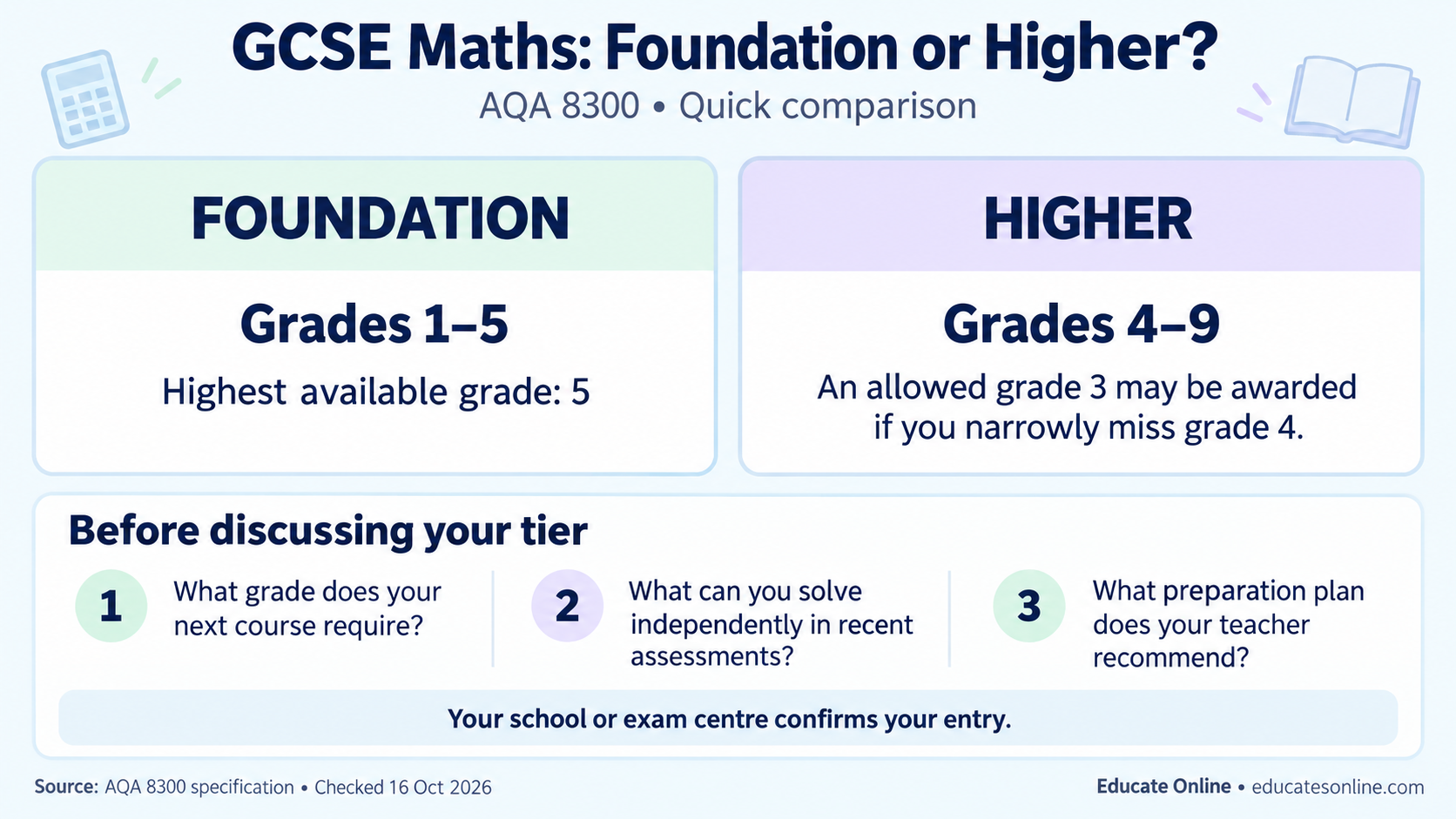
Foundation and Higher: grades, papers and the main risk
| Question | Foundation | Higher |
|---|---|---|
| Which grades are targeted? | 1–5 | 4–9 |
| Can it award a grade 6? | No | Yes, if the required standard is reached |
| Which papers are taken? | Three at Foundation tier | Three at Higher tier |
| Time and calculator rules? | 90 minutes per paper; one non-calculator and two calculator papers | The same time and calculator pattern |
| What happens below the normal grade range? | Below the grade 1 minimum: U | An allowed grade 3 is available just below grade 4; below that minimum: U |
See AQA’s assessment overview and awarding rules. Higher includes additional content and more demanding problems. Foundation still requires accurate methods, reasoning and clear explanations.
Which tier should you discuss with the school?
- A required grade above 5: discuss Higher and identify the missing skills and teaching time. An entry change alone will not close those gaps.
- A target of 4 or 5 with inconsistent work: compare recent attempts at suitable papers with the teacher. Look at which questions the student can actually solve, not just the tier label.
- Strong routine answers but difficulty with unfamiliar problems: practise choosing and explaining methods before treating confidence with a worked example as independent understanding.
Do not compare a raw percentage on Foundation with the same percentage on Higher as if the tasks were identical. When a school uses a past paper, ask which board, series and matching grade boundaries inform its judgement. A single paper remains one piece of evidence.
Gather evidence before discussing a change
- Write down the next-step requirement. Record the exact course and institution, the published Maths requirement and the date you checked it. Do not assume every sixth form or college has the same entry rules.
- Collect recent independent work. Use more than one assessment. Record the paper, tier, date, time allowed and whether notes or help were used.
- Separate missing knowledge from execution errors. “Could not start the equation” needs a different response from “used the right equation but lost a minus sign.”
- Ask what remains untaught. A low result on unfamiliar content is not the same as persistent difficulty with taught content.
- Agree a review point. Ask the school when it needs to decide the entry and what evidence would justify changing it. Entry decisions belong with the school or examination centre.
A six-question discussion starter
Try these without notes. Keep all working and write a brief explanation even if you use a quick mental method. Do not turn the total into a predicted grade: six questions cannot sample a whole specification, and the questions are not labelled as official tier boundaries.
- A jacket costs £80. It is reduced by 15%. What is the sale price?
- Two quantities are in the ratio 3:5 and total 64. Find both quantities.
- Solve 3(2x − 1) = 4x + 9.
- A straight line passes through (2, 7) and (6, 19). Find its equation.
- A rectangle has width x cm and length (x + 3) cm. Its area is 28 cm2. Find its positive width.
- Simplify (x2 − 9)/(x − 3), stating the value of x that is excluded.
Worked answers: look at the method, not just the result
1. Percentage change
10% of £80 is £8 and 5% is £4, so the reduction is £12. The sale price is £68. Alternatively, 80 × 0.85 = 68. An answer of £12 finds the discount but does not answer the question; underline the quantity being asked for.
2. Sharing a ratio
There are 3 + 5 = 8 equal parts. Each part is 64 ÷ 8 = 8. The quantities are 24 and 40. Check both their sum and their ratio. Dividing 64 by 3 and by 5 separately does not share one total in the given ratio.
3. Solving an equation
Expand first: 6x − 3 = 4x + 9. Subtract 4x and add 3 to obtain 2x = 12, so x = 6. Substitute back: both sides equal 33. Write one change per line if several mental steps lead to sign errors.
4. Connecting coordinates and a line
The gradient is (19 − 7)/(6 − 2) = 3. Substitute (2, 7) into y = 3x + c: 7 = 6 + c, so c = 1. The equation is y = 3x + 1. Check it with the other point. The gradient is a change in y divided by the corresponding change in x.
5. Turning a situation into a quadratic
The area gives x(x + 3) = 28, hence x2 + 3x − 28 = 0. Factorising gives (x + 7)(x − 4) = 0. The algebraic solutions are −7 and 4, but a width must be positive, so x = 4 cm. The length is 7 cm and the area checks as 28 cm2.
6. Cancelling factors carefully
The numerator is (x − 3)(x + 3). Cancelling the factor x − 3 gives x + 3, with x ≠ 3. The restriction remains because the original denominator cannot be zero. You can cancel common factors; you cannot simply cross out terms in a sum.
Turn the work into a useful conversation
Choose two examples where the student got stuck. For each, ask: “Did I understand the question? Did I know a possible method? Could I carry it out? Did I check the result?” These answers are more actionable than saying the student is “bad at algebra”.
For the next practice session, change the numbers while keeping the skill the same. After that, mix the question with other topics so the student has to identify the method. If a solution only works immediately after seeing the answer, it needs another independent attempt later.
Bring the work to the teacher alongside recent full assessments. Ask which gaps matter most for the current tier, what additional content a change would require and when progress will be reviewed. Avoid making a tier decision from this checklist alone.
Where to go next
Explore GCSE tutoring support or GCSE Maths tutoring for subject-focused help. If you are considering A Level Maths afterwards, our algebra readiness check gives another set of original worked examples.
To discuss support, request a free trial with the student’s board, current tier and the topics they find difficult. A trial request is an enquiry; availability and arrangements need confirmation.
Assessment sources checked 16 October 2026. Examples and checklist are original learning material from Educate Online, not AQA questions or an endorsed assessment.
Frequently asked questions
Can you get a grade 6 on Foundation GCSE Maths?
No. For AQA GCSE Mathematics 8300, Foundation awards grades 1–5. If a next course requires grade 6 or above, discuss Higher-tier preparation and the entry decision with the school.
Is a grade 4 or 5 easier to achieve on Higher?
There is no reliable answer from the tier name alone. The papers differ in content and demand. Compare recent independent work with the teacher, using the correct paper and its own grade boundaries.
Can a student switch tiers close to the exam?
Ask the school or examination centre about its decision process, entry deadlines and remaining teaching time. A tutor can help identify gaps but cannot change the examination entry.
Does getting all six practice questions right prove Higher readiness?
No. Six questions do not cover a full specification or the demands of complete papers. Use the working to identify strengths and gaps alongside school assessments.
Sources
External references for the topics covered in this guide.