5 A Level Revision Techniques: Worked Examples and an Error Log
Effective A Level revision combines recalling what you know, applying it to questions and correcting the first step that went wrong. Use five connected techniques: retrieval practice, spaced review, topic-to-mixed questions, an error log and timed exam practice. Choose the next task from your actual work rather than repeating whichever method feels easiest.
This guide provides original examples for Maths, sciences and essay subjects. They illustrate study methods, not official exam questions or mark schemes. Your specification, teacher and awarding body’s materials remain the reference for what your course assesses.
A useful revision cycle
- Attempt a question without the answer in view.
- Check the method and the explanation, not only the final result.
- Repair one precise gap.
- Try a fresh question and return to the skill later.
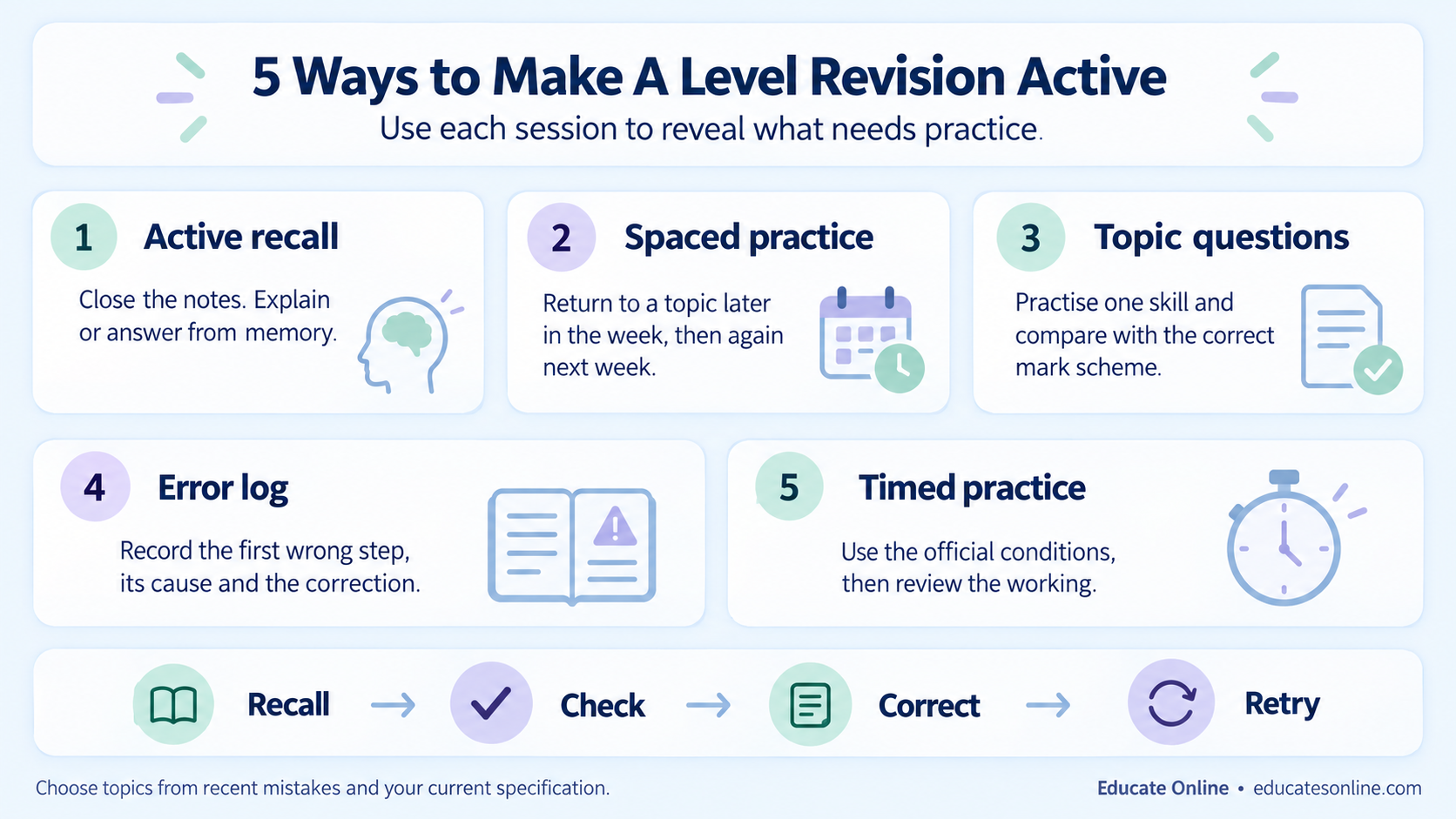
1. Retrieve information before reopening your notes
Active recall means bringing knowledge to mind rather than recognising it on a page. Cornell’s study guidance describes using a blank page to expose what you can and cannot recall. Keep the first attempt, check it, and add corrections in a different colour so the gaps remain visible.
- Biology: sketch a process from memory and explain what happens at each labelled stage; then compare with the relevant course material.
- Maths: solve a short unfamiliar equation and explain why each transformation is valid.
- English Literature: plan an answer to a particular question, using evidence from the text and explaining how it supports the argument.
A flashcard can help with a precise definition or relationship. A large card containing an entire essay may only test whether the page looks familiar. Match the retrieval task to the skill: remembering a term, selecting a method and constructing an argument are different jobs.
2. Revisit the topic after a gap
The Institute of Education Sciences practice guide recommends distributing learning over time and using quizzes to revisit content. There is no single interval that works for every topic and learner. The practical test is whether you can retrieve and apply the idea after the earlier explanation is no longer fresh.
For example, learn and practise a method on Monday, retry a fresh question on Thursday, and include another question the following week. If Thursday’s attempt fails, return to the missing step and schedule another check. If it is secure, revisit it within a mixed task instead of spending every session on identical questions.
Write those review dates into a weekly study plan. Leave room for current homework and assessment deadlines. Spacing is a way of arranging useful practice, not a reason to create an elaborate calendar that you cannot follow.
3. Move from worked examples to independent and mixed questions
When a method is new, study one clear worked example and explain each line. Then cover it and attempt a comparable question. Once the method becomes more secure, mix it with other topics so the question itself must tell you which approach to choose.
A Maths example: choosing and checking a method
To solve x2 − 5x + 6 = 0, factorise to get (x − 2)(x − 3) = 0. Therefore x = 2 or x = 3. Substituting each value into the original equation checks the result. Writing only the two factors is incomplete if the question asks you to solve.
Now try x2 − 7x + 10 = 0 without looking back. Its roots are 2 and 5. Later, mix a factorisable quadratic with a linear equation and another problem requiring a different method. Explain the choice before doing the algebra. These examples are learning prompts, not a measure of your predicted grade.
For essay subjects, the equivalent move is from examining a well-reasoned paragraph to writing your own paragraph for a new question. Check that the evidence supports the particular claim you made rather than merely relating to the general topic.
4. Keep an error log that changes the next attempt
“Careless mistake” is rarely a useful instruction for tomorrow. Identify the first incorrect step and write a small action that would prevent it. Keep only errors that reveal something worth practising; the log should be a tool you use, not a second set of beautiful notes.
| What happened | Likely gap | Next independent check |
|---|---|---|
| Stopped after factorising a quadratic | Confused rewriting an expression with solving an equation | Solve a fresh equation and substitute both proposed roots |
| Recalled a scientific term but could not explain the process | Definition learned without connected reasoning | Explain the steps aloud, then answer a new process question |
| Used a relevant quotation without linking it to the essay claim | Evidence selected without analysis | Write two sentences explaining exactly what the words suggest |
| Lost time rereading a long question | Unclear requested output or weak plan | Underline the command and quantities, then write a brief approach before answering |
Record the question source and date so you can revisit it, but use a new question to check transfer. Remembering the corrected answer to the same question is weaker evidence than handling a changed example independently.
5. Use timed papers to practise the actual conditions
Choose papers for your awarding body, qualification, subject and current specification. AQA’s revision resources, for example, explain how specifications, past papers and mark schemes support preparation. Use your own board’s equivalent resources if you study a different course.
Follow the relevant time limit and permitted equipment. If you normally have approved access arrangements, ask your school how to reflect them in practice. Keep an honest record of whether notes, pauses or help were used; an assisted practice attempt should not be treated as a closed-book mock.
Afterwards, compare your response with the mark scheme and ask a teacher about ambiguous marking. Prioritise the errors that reveal a method or knowledge gap. There is no fixed rule that every paper needs exactly the same amount of review time: review until you understand the important corrections and have selected the next practice tasks.
Start your next revision session
Choose one weak skill, one fresh question and one later review date. If algebra is the obstacle, try our A Level Maths readiness questions. For recurring gaps across subjects, bring your working and error log when discussing subject tutoring; they give a clearer starting point than a target grade alone.
Frequently asked questions
Is active recall enough for A Level revision?
It is a useful part of revision, but you also need to apply knowledge, choose methods, develop arguments and practise the assessment format. Follow recall with questions and feedback that match your subject.
How often should I revisit a topic?
Use separate sessions and adjust the gap based on what you can still do independently. A return later in the week and another the following week can be a starting example, not a compulsory formula.
What belongs in a revision error log?
Record the question source, first wrong step, likely reason and a specific next check. A fresh question is useful because it tests whether the corrected method transfers beyond the answer you just saw.
When should I start full timed papers?
Use them when you have enough relevant knowledge to make the attempt informative, while keeping topic practice for weak areas. Follow the correct board's conditions and ask your school how approved access arrangements should be reflected.
Sources
External references for the topics covered in this guide.
- Effective Study Strategies (opens in a new tab)Cornell University Learning Strategies Center · lsc.cornell.edu
- Organizing Instruction and Study to Improve Student Learning (opens in a new tab)Institute of Education Sciences · What Works Clearinghouse · ies.ed.gov
- Revision resources: specifications, past papers and mark schemes (opens in a new tab)AQA · aqa.org.uk