First Online Tutoring Session: A Parent’s Preparation Guide
To start online tutoring, choose one learning priority, prepare a small sample of current work and test how the student will speak, write and share answers. The first session should establish a starting point and a useful next step. It does not need to cover a whole topic or produce an immediate grade improvement.
This guide is about adding tutoring alongside school. Educate Online is not an online school and does not replace enrolment, issue transcripts or award school credits or qualifications.
- Bring the exact course details and one question in the student’s own words.
- Test the technology using the device and space you will actually use.
- Give the student room to attempt work and ask for help.
- Review an independent attempt and agree manageable practice after the session.
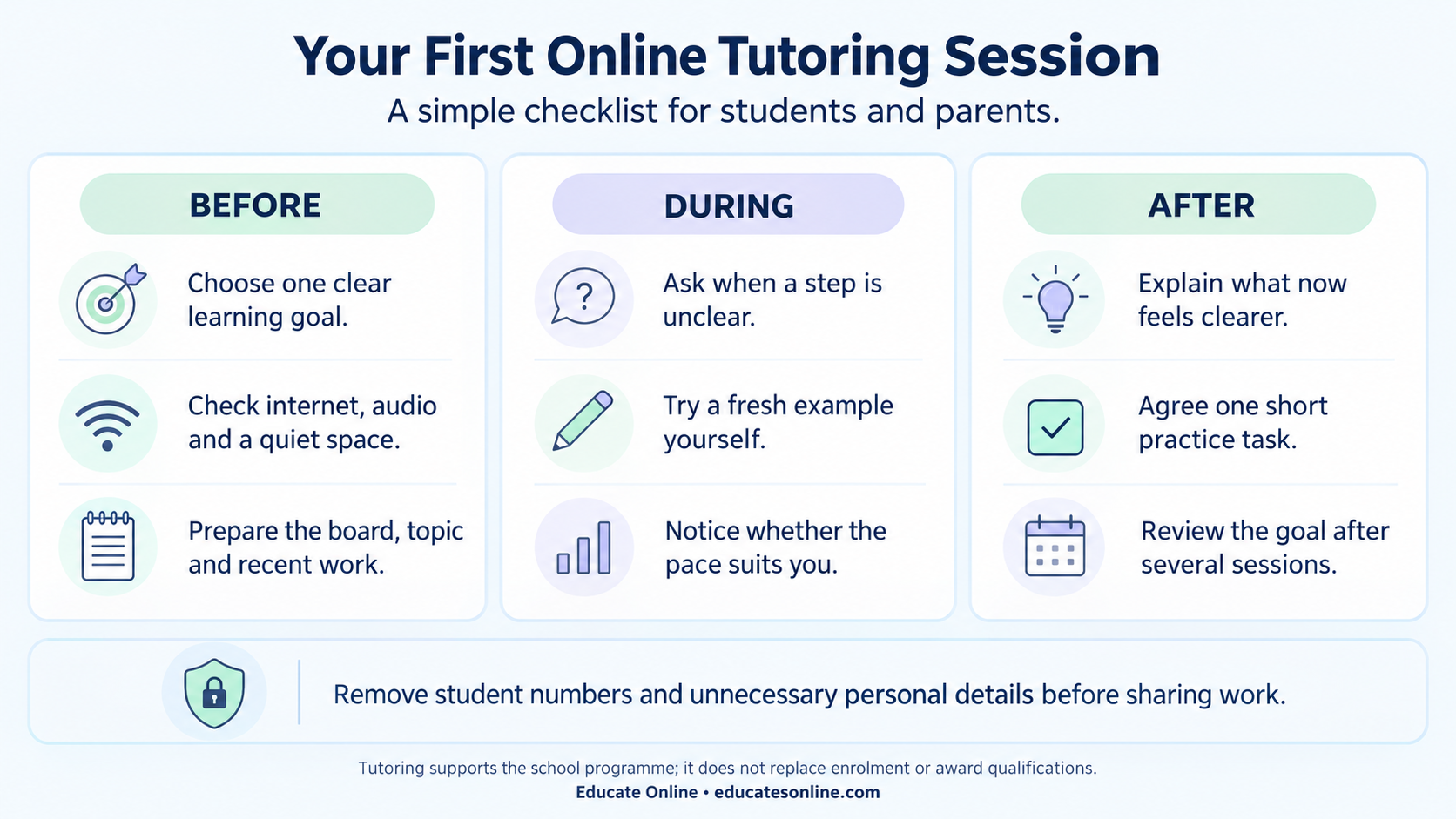
Choose one starting goal
“Get better at Science” is a broad ambition. “Explain why the graph levels off” identifies something a tutor and student can investigate together. Use recent schoolwork or feedback to select a first priority, while allowing the tutor to check whether an earlier gap is causing the difficulty.
| Current concern | Useful first-session focus | What to bring |
|---|---|---|
| Maths answers are often wrong | Find the first incorrect step in one method. | Two attempted questions with the working left visible. |
| An essay has unclear feedback | Understand one comment and improve a short practice paragraph. | The task, marking criteria and relevant teacher comment. |
| Revision feels unmanageable | Identify one weak topic and a realistic practice task. | The course details, upcoming assessment and recent work. |
| The learner avoids asking questions | Practise explaining where understanding stops. | A question the learner chose, even if only partly attempted. |
The EEF’s tuition evidence review supports targeting identified needs, connecting support with classroom learning and checking progress. It does not establish that one session or one provider will produce a particular result.
The first-session preparation checklist
Before the day
- Confirm the appointment: date, time zone, duration, joining instructions and how to contact the provider if access fails.
- Share course context: year or grade, subject, curriculum, board and tier where relevant, and the current topic.
- Select useful work: a small sample and one relevant teacher comment. Keep mistakes visible; remove personal identifiers that are unnecessary for teaching.
- Ask about learning access: explain any practical adjustment the student uses, such as larger text, extra thinking time or an alternative way to show working.
- Confirm arrangements: lesson format, expected materials, communication, supervision, recording if applicable, and payment or cancellation terms.
Shortly before joining
- Charge the device or connect its power supply.
- Check the microphone, speakers or headphones, and the camera if required.
- Open the approved lesson link and test document or whiteboard access if a test is available.
- Have paper, pens, the relevant textbook or text, and any course-appropriate calculator ready.
- Close unrelated tabs and notifications; choose a space where the student can concentrate.
- Keep a parent or agreed contact reachable in line with the student’s age and the arrangements made.
A laptop or tablet may make written work easier to share than a small phone screen, but check the provider’s actual requirements before buying equipment. Cornell’s online-learning resources offer ideas on organising a study space, planning and communication that families can adapt.
What should happen during the first session?
The tutor needs to learn how the student approaches a task. A useful session can include a short conversation about the goal, an initial attempt, an explanation or worked example, and a fresh attempt with less help. The exact balance depends on age, subject and the difficulty uncovered.
Students can use simple phrases such as “I understand up to this line” or “Could I try one myself?” Parents can help the learner settle and explain practical needs, then give them space to respond. Agree appropriate supervision with the provider; do not assume the same arrangement suits every age or family.
Look for participation rather than a perfectly completed worksheet. If the tutor does all the calculations or rewrites the whole answer, the family has less evidence of what the student can do independently. Use our 15-question trial checklist when deciding whether the match is right.
Common first-session problems and useful responses
| Problem | Try this | Agree afterwards |
|---|---|---|
| The tutor cannot see the working | Use the agreed upload method or show one clearly labelled step at a time. | A reliable way to share written answers next time. |
| Audio or connection interrupts learning | Tell the tutor promptly and use the provider’s agreed contact route. | How lost time or rescheduling will be handled under the terms. |
| The work is too difficult | Identify the first unfamiliar step and move to a smaller example. | The earlier skill to practise. |
| The student is quiet | Allow thinking time and invite a written response or a specific question. | A participation approach the student finds manageable. |
| The pace feels too fast | Ask for one step to be repeated, then attempt it independently. | A clearer pace or shorter task sequence. |
These are practical suggestions, not a promise about a provider’s equipment, platform features or cancellation policy. Confirm the arrangements that apply to your booking.
Use a short review after the lesson
Ask the student three questions: What can you explain more clearly now? Which step is still difficult? What will you try before the next session? Write the answers beside the original goal. The tutor’s next task should respond to the remaining difficulty rather than simply add more work.
For example, a learner who could only copy a rearrangement at first might now explain the operations but still make sign errors. That suggests a focused practice need. It does not establish a predicted examination grade. Keep one fresh attempt to discuss later and check whether the learner can still use the method without the example open.
At an agreed review point, compare the student’s work, participation and relevant school feedback with the starting goal. If the approach is not helping, discuss a change in task, pace, practice or tutor match. Our study-planning guide can help fit practice around school commitments.
Keep communication and school responsibilities clear
The NSPCC’s parent guidance provides questions to ask about suitability and boundaries. Use the agreed contact channels and raise concerns promptly. A tutor can explain subject content and guide practice; assessed work must remain the student’s own, and school decisions remain with the school.
Review Educate Online’s supported curricula, subjects and Help Centre. When requesting a trial, include the confirmed course and one specific learning need so the first discussion can be useful.
Frequently asked questions
Does online tutoring replace school enrolment?
No. Educate Online provides tutoring alongside a school programme. It does not enrol students as a school, issue transcripts or award school qualifications or credits.
What should I prepare for the first session?
Choose one learning goal, check the device and audio, and prepare the exact course, current topic and recent work. Remove student numbers and other unnecessary personal details before sharing documents.
How can we judge whether the first session was useful?
Ask the student what became clearer and what remains difficult. Look for a fresh independent attempt, an appropriate pace and one concrete next step rather than a promise of immediate grades.
How should we review ongoing tutoring?
Revisit the original goal using the student's work and school feedback, agree manageable practice and discuss concerns early. Confirm scheduling and other practical arrangements with the provider.
Sources
External references for the topics covered in this guide.
- One to one tuition: evidence and implementation (opens in a new tab)Education Endowment Foundation · educationendowmentfoundation.org.uk
- Finding a tutor for your child (opens in a new tab)NSPCC · nspcc.org.uk
- Learning online: planning, space and communication (opens in a new tab)Cornell University Learning Strategies Center · lsc.cornell.edu